


The gap between organisations that treat corporate events as a line item and those that treat them as a strategic lever has never been wider. After several years of experimentation with format, technology, and audience expectation, the novelties that survived are becoming standards, and the ones that did not are being quietly dropped. For event managers operating in the MICE sector, this is less a moment to chase new trends and more a moment to decide which ones are worth operationalising at scale.
The Market Context: Why Corporate Event Trends Matter More Than Ever
Before discussing individual event trends, it is worth grounding the conversation in scale. According to Grand View Research, the global MICE market was valued at USD 945.6 billion in 2025 and is projected to reach USD 1,028.9 billion, growing at a CAGR of 8.6% through 2033. That is not the growth trajectory of a sector in flux, it is the trajectory of a sector with structural demand. Corporations are not pulling back from events; they are becoming more selective about which events earn budget and why.
That selectivity is precisely what makes staying on top of corporate event trends a professional imperative, not a nice-to-have. The planners who understand what is driving attendee expectations and stakeholder ROI calculations are the ones winning mandates and retaining clients.
AI in Events: Moving from Pilot to Production
If there is one shift that defines the current moment, it is that AI in events is no longer experimental. It has moved into the operational layer of planning and delivery. A 2025 survey conducted by Event Tech Live found that 45% of event organisers and directors were already actively using AI tools, with data analytics (20%) and personalisation (18%) as the two leading use cases.
What that means in practice varies considerably. At the basic end, AI is handling registration communications, content summaries, and attendee segmentation. At the more sophisticated end, it is powering real-time matchmaking, predictive session scheduling, and post-event attribution modelling. The PCMA Convene survey from 2025 found that 65% of event professionals reported using AI tools, up from 62% the previous cycle. A steady climb that suggests adoption is broadening, not plateauing.


What is particularly relevant for corporate event managers is that AI in events is delivering measurable operational value, not just experiential novelty. Teams using AI-driven automation are freeing up planning capacity that can be redirected toward the relational and creative dimensions of events, the parts that cannot be automated and that often determine whether an event is remembered or forgotten.
Eventscase has published a detailed piece on AI for Events: 8 Practical Applications You Can Implement in Your Strategy that is worth reading alongside this, particularly for teams trying to identify where to introduce AI without disrupting existing workflows.
The Intentional Return of In-Person
One of the more nuanced corporate event trends of 2026 is the recalibration of what in-person is for. The question is no longer whether to hold events in person (that debate has been settled) but what in-person uniquely delivers that no other format replicates.
The answer the sector is converging on is relational density: the volume and quality of meaningful human connections that happen when people share physical space with a shared purpose. Companies are redesigning their physical gatherings with structured networking, curated matchmaking sessions, and intentional agenda design that trades filler for focus. The old model, a keynote, a panel, a networking drinks reception, is giving way to formats that are engineered for connection rather than merely enabling it by proximity.
This has real implications for how corporate event managers approach venue selection, session sequencing, and technology infrastructure. An in-person event in 2026 is expected to generate connection data, not just attendance data. Organisers are under pressure to show that the conversations that happened mattered, which requires both the right environment and the right tools to capture and analyse what occurred.
The Rise of Micro-Formats and Portfolio Thinking
Another of the defining event trends reshaping corporate calendars is the deliberate move away from the single annual flagship and towards a portfolio of smaller, targeted formats. Regional roadshows, executive roundtables, product immersion days, and community-driven gatherings are replacing or supplementing the mega-conference model for many organisations.
The logic is straightforward: smaller events are easier to personalise, faster to iterate, more cost-effective per meaningful interaction, and significantly easier to measure. For senior audiences in particular, exclusivity and intimacy often outperform scale. A group of twenty decision-makers in a focused half-day workshop frequently generates more pipeline or alignment than the same twenty people in a crowd of two thousand.
This portfolio approach also distributes risk. When an annual conference represents the entirety of an organisation’s event investment, a single operational failure or external disruption has outsized consequences. Spreading investment across a series of micro-formats creates redundancy and ongoing market presence throughout the year.
Sustainability as a Structural Requirement
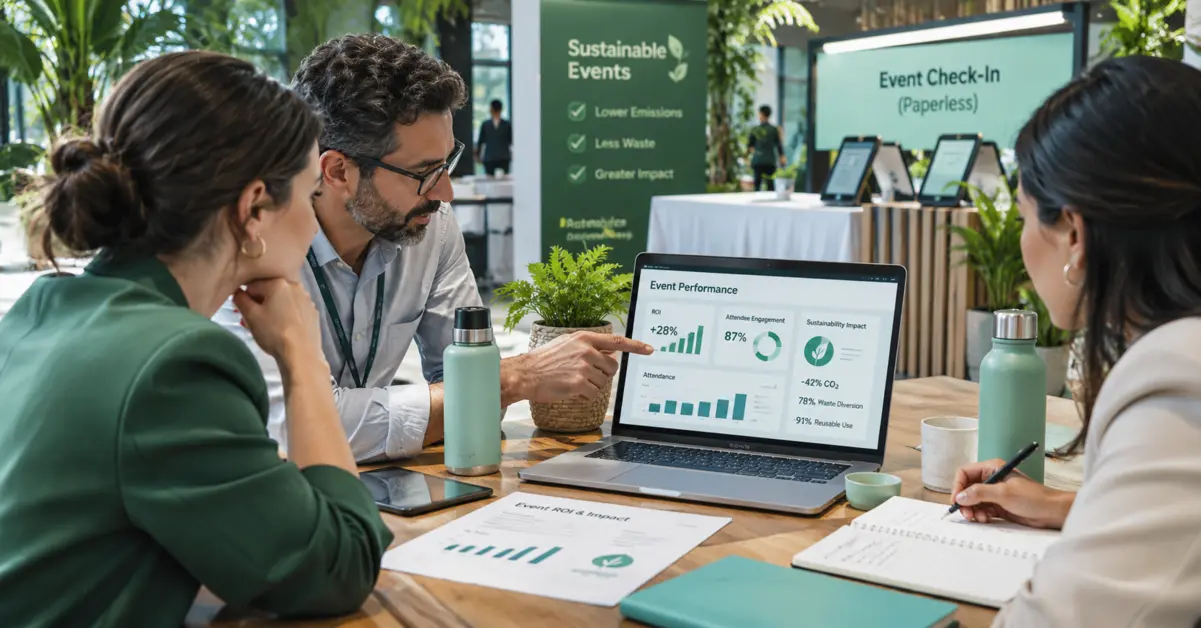
Sustainability has matured from a talking point into a procurement criterion. An increasing number of corporate clients are including sustainability requirements in their event briefs. This includes expectations around venue certification, catering sourcing, materials lifecycle, digital-first delegate communications, and post-event carbon reporting.
For event managers, this means sustainability can no longer be addressed as an afterthought or managed through a checklist appended to the existing planning process. It needs to be built into the brief from the outset, with suppliers selected partly on the basis of their ability to provide verifiable sustainability credentials. The planners who have already embedded this into their standard operating procedures are finding it a differentiator; those who have not are finding it a pressure point.
Data, Attribution, and the ROI Conversation
Perhaps the most consequential shift in corporate event trends over the past 24 months has been the professionalisation of event measurement. C-suites are asking harder questions: what changed because we gathered? What decisions were made, relationships formed, or behaviours shifted as a result of the event? And how do we know?
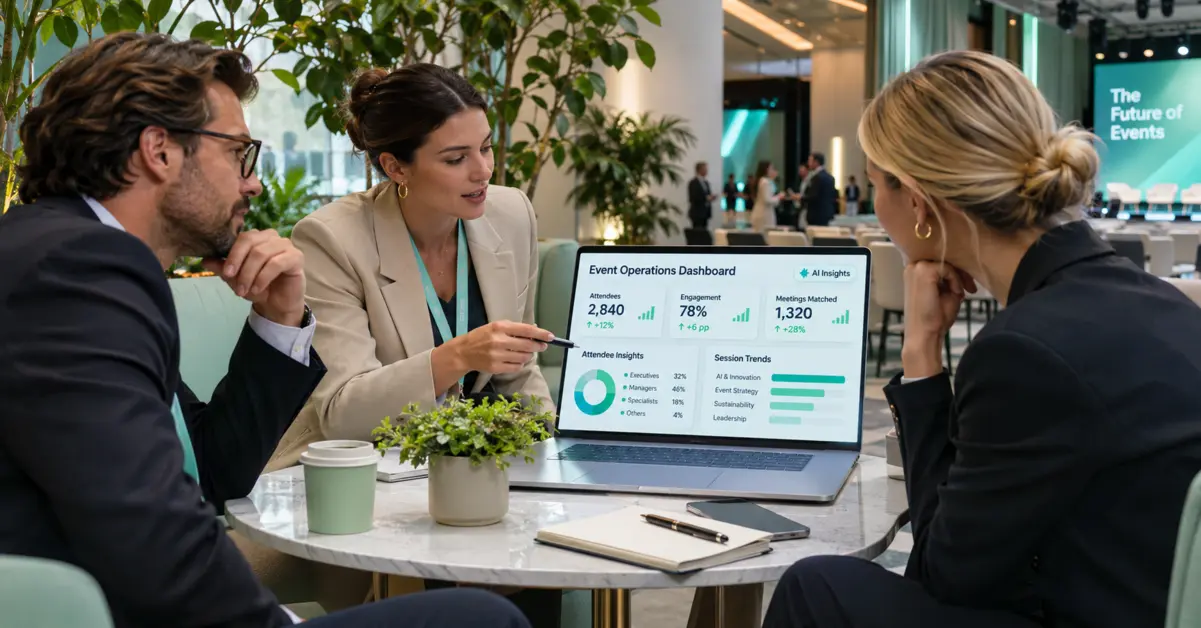
The honest answer for many organisations until recently was: we do not, with any precision. That is changing. Badge data, app engagement metrics, post-event survey data, and CRM integration are being combined into attribution models that tell a more complete story of event impact. The organisations making the most progress here are those that have consolidated their event data into a single environment rather than leaving it fragmented across multiple tools.
This is an area where platform choice matters significantly. Corporate event management software that integrates registration, app engagement, networking activity, and analytics into a unified dashboard makes the ROI conversation possible in a way that point solutions simply cannot. It also makes the data available in real time, allowing organisers to make in-event adjustments based on what is actually happening rather than what was planned.
For further thinking on how data intersects with the attendee experience, the Eventscase blog post on optimising the attendee experience at corporate events covers the operational detail of how personalisation and measurement work together in practice.
Personalisation at Scale: Still the Hardest Problem
Personalisation remains one of the most discussed and least consistently delivered corporate event trends. The aspiration (giving every attendee an experience that feels tailored to their role, interests, and goals) is well understood. The execution gap is significant.
The challenge is that genuine personalisation requires data infrastructure, segmentation logic, and content flexibility that most corporate event teams are still building. AI in events accelerates this by analysing registration data, past engagement patterns, and stated preferences to surface relevant sessions, suggest networking targets, and customise communications but it requires a foundation of clean, connected data to work from.
The teams making progress here are not necessarily the ones with the largest budgets. They are the ones who have invested in platform consolidation, data hygiene, and clear thinking about what a “personalised experience” actually means for their specific audience. That clarity of definition is often what separates a genuinely personalised event from a generic event with a few attendee’s names in the welcome email.
What This Means for the Practitioners Running the Calendar
The corporate event trends are collectively pointing in one direction: events are becoming more precise. More precise in their objectives, their audience targeting, their use of technology, their measurement frameworks, and their sustainability commitments. The era of the event as a broad-brush activity is giving way to the event as a deliberately engineered intervention with defined outcomes.
For MICE professionals, this demands a broader skill set than pure logistics: data literacy, stakeholder management, technology fluency, and strategic thinking about what events are actually trying to achieve. It also demands tools that match the complexity of the job.
Eventscase has published resources that address several of these dimensions in depth including the Definitive Guide to Implementing Artificial Intelligence in your Event Strategy which is a useful place to explore how AI fits into a broader event strategy rather than treating it as a standalone capability.
The organisations that will get the most out of their event investment are those treating corporate events not as a production challenge, but as a business function with its own strategic logic, data feedback loops, and measurable contribution to organisational goals.