

The revival of internal events is not a passing trend, but a response to measurable organisational pressure. Global engagement fell from 23% in 2023 to 21% in 2024 and continued to decline in 2025; in addition, one in five employees worldwide said they felt lonely for much of the working day in 2024. At the same time, distributed work has become firmly established: at Microsoft, the proportion of fully co-located teams dropped from 61% before 2020 to 27% in April 2023, and a randomised controlled trial published in Nature found that hybrid work reduced attrition by one third without harming performance. The reasonable conclusion is that internal events are returning, but not as a replacement for hybrid work: they are returning as “moments that matter”.
The data also helps separate what is useful from what is merely decorative. Microsoft identifies three moments where physical co-presence creates greater value: team cohesion, onboarding and project kick-offs. Atlassian reported more than 1,600 Intentional Team Gatherings since 2022, with an average of 16 attendees, 96% satisfaction and a positive effect on connection that usually lasts around four months. Gallagher, meanwhile, places in-person company-wide town halls, in-person events for managers and virtual town halls among the most effective internal formats.
For HR and internal communication teams, this changes the conversation. According to Qualtrics, organisations that increased employee listening reached 87% engagement, compared with 44% among those that listened less, although only 25% of employees say their company increased the frequency of that listening. At the same time, the most comparable public benchmark for corporate meetings and events puts the average global cost at US$168 per attendee per day in 2025 and US$172 in 2026. In other words: internal events are coming back because they matter, but in 2026 they must be justified with objectives, data and governance.

Why internal events are returning
The operational context explains this shift. In 2025, Microsoft reported that 80% of the global workforce feels they do not have enough time or energy to do their work and that, on average, employees experience an interruption from a meeting, email or notification every two minutes. In parallel, Gallup estimated that the fall in engagement in 2024 cost the global economy US$438 billion in productivity, and that a fully engaged workplace could add US$9.6 trillion to the global economy. In this scenario, the question is not whether it is worth bringing people together, but why. The internal events that survive in 2026 are those that reduce friction, increase clarity and rebuild bonds that a digital-only calendar is failing to sustain.
Not a return to the office
The evidence reviewed does not suggest that the solution is simply “more in-person attendance” in the abstract. Microsoft concludes that the moments where physical presence creates the greatest value are cohesion, onboarding and kick-offs; furthermore, in its internal comments, 37% of mentions about what the organisation should offer in person referred to social and team-building activities, not more hours of co-working. GitLab, a remote-first benchmark, maintains an explicit bias towards asynchronous work, but keeps in-person rituals for what a video call cannot easily replace: its company-wide Contribute gathering and high-intensity quarterly executive meetings. The lesson is clear: internal events should not copy the office; they should be reserved for what neither the office nor distributed work can solve on their own.
Connection has a measurable impact
When connection declines, the employee experience deteriorates. Gallup concluded that in 2024, 20% of employees felt lonely for “a lot of the previous day”; among those working fully remotely, the figure rose to 25%, compared with 16% among those working fully on-site. O.C. Tanner adds another useful point: 64% of employees say they often find new ideas through conversations with colleagues, and 73% say that receiving recognition inspires them to do better work. In other words, talking, learning and recognising people publicly are not “soft” activities; they are concrete mechanisms that explain why internal events are once again taking up budgetary space.
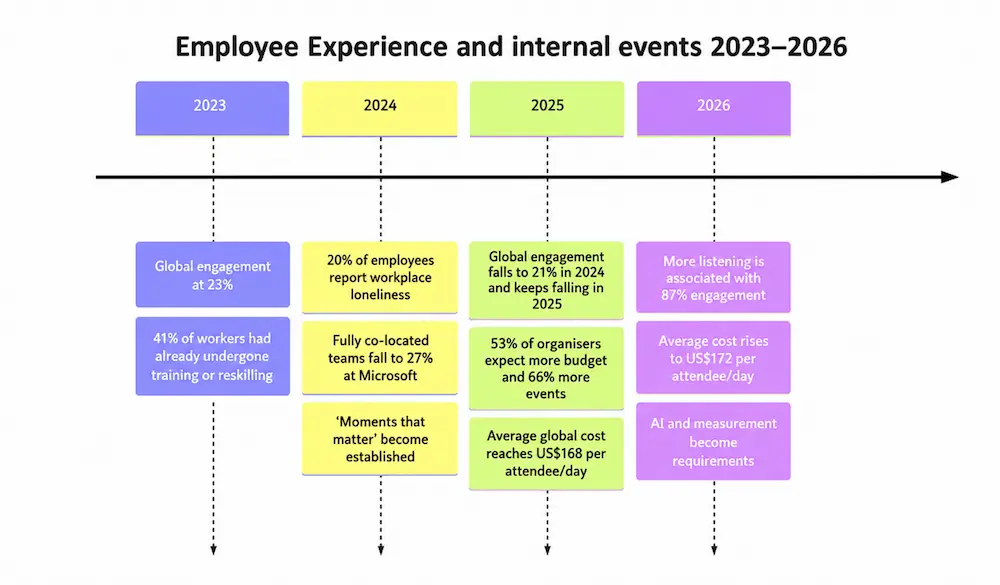
The 2023-2026 journey can be summarised in this timeline:
The reading of the chart is clear: 2023-2024 established a stable base of hybrid work and a growing need for connection; 2025 reopened investment in in-person experiences and accelerated the urgency around upskilling; and 2026 consolidates listening, AI governance and measurement as conditions for internal events to have strategic legitimacy.
Which formats work best in 2026
If the criterion is to design “moments that matter”, the most valuable formats are not necessarily the largest, but those that best solve a specific organisational problem: alignment, manager activation, onboarding acceleration, knowledge sharing or stronger relationships. Gallagher provides one of the most useful public comparisons for internal communication; Atlassian offers a strong case for team gatherings; and GBTA/CWT provides the best public benchmark for comparable in-person costs.
There are two important readings here. The first: in-person internal events continue to show very strong performance in alignment and leadership. The second: virtual remains useful for scale, but it is not enough when the goal is cohesion, onboarding or creativity. This aligns with Microsoft, which associates physical presence with cohesion, onboarding and kick-offs, and with Atlassian, which designs three- to five-day gatherings that combine socialisation with high-priority work.
The rebound is not only cultural; it is also budgetary. In 2025, 53% of organisers expected to increase budgets and 66% planned to hold more events, while 57% were already reporting attendance growth at their in-person events. For 2026, the picture is more demanding: 72% of planners expect event costs to rise by up to 20% compared with 2025, although 69% also expect budgets to increase. For internal events, this creates a dual pressure: to continue gaining space on the agenda while doing so with more business-focused criteria.

How to measure without vanity metrics
Attendance is no longer enough. The most useful way to measure internal events in 2026 is to build a chain of indicators across three layers: operations, Employee Experience and business. The first includes registration, show rate, dwell time, questions, participation and content consumption; the second includes engagement, inclusion, wellbeing, trust in leadership and intent to stay; the third includes time to productivity for new starters, change adoption, internal mobility, voluntary turnover and progress in critical skills.
The before-and-after design is particularly useful. Atlassian measured its gatherings with surveys in the month before and the month after, and observed statistically significant impacts on team connection, alignment and time to develop ideas. That logic — baseline, intervention, observed change — is much more defensible than an isolated NPS score. Gallagher also adds a practical warning: only 60% of communication teams use measurement data to build business cases. Until that changes, many internal events will continue to be perceived as reputational spend rather than an operational tool.
It is also worth separating cost from return. The GBTA/CWT benchmark helps budget cost per attendee per day, but it does not establish a universal standard ROI by format. That part depends on the objective: if the event is for onboarding, the relevant indicator is not only satisfaction, but speed of integration; if it is a manager roadshow, priority clarity and content quality matter; if it is a learning event, the value lies in skills transfer, certifications or mobility. In 2026, useful internal events are those designed from the start around an indicator that leadership recognises as its own.
Roadmap for HR and internal communication teams
For medium-sized and large companies, the recommendation is not to fill the calendar with internal events. It is to build a short, purposeful portfolio: a corporate all-hands for strategy and culture; manager roadshows when relevant changes are taking place; onboarding cohorts with selective in-person elements; and team gatherings when there is a clear need for integration, creativity or coordination. Microsoft and GitLab point to the same conclusion: use in-person time for relationships and complex coordination, and leave transactional matters to asynchronous work.
The technology stack also matters. Gallagher shows that enterprise chat reaches 75% usage and 75% effectiveness, while employee apps reach 70% effectiveness despite still having low usage, and social engagement platforms deliver 68% effectiveness. The opportunity exists, but organisational maturity remains uneven.
The underlying conclusion is simple. The revival of internal events is not about going back to the old format of room, stage and slides. It is about using scarce, well-designed gatherings to align, listen, learn, recognise and activate managers. When that happens, the event stops being cosmetic spend and becomes a key piece of Employee Experience. That is the real opportunity for 2026.