

The conversation around AI for events is often framed incorrectly. Not because the technology is not useful, but because it is too often presented as a dilemma between efficiency and humanity. In the events sector, this framing falls short: an event works because people feel that someone has thought about their experience, anticipated their needs, and knows when to intervene at the right moment.
That is why AI for events is not a replacement, but rather a way to automate so that the team can deliver more value. This is the balance point: using technology to absorb operational friction while reserving human judgement for sensitive communication, contextual interpretation and relationship-building.
What AI for events should automate
The best AI for events does not start with the spectacular, but with the repetitive. In practice, there are four areas where automation usually makes immediate sense.
Registration, classification and operational communications
Registration is no longer just about collecting data; it becomes a continuous flow of validations, segmentation, updates and communications as volume increases. Here, AI for events can help classify profiles, tailor messages, trigger automated responses and reduce manual tasks that consume team time without adding distinctive value. At Eventscase, we already focus on automating registration processes, segmentation and communications as part of our technology offering.
Handling frequently asked questions
Another clear application of AI for events is supporting repetitive queries: schedules, access, rooms, agenda changes, documentation or service locations. This type of instant assistance reduces waiting times and prevents the team from becoming a permanent help desk. EVA, our virtual assistant, already applies this logic in attendee support.
Automating does not mean hiding the team
There is an important nuance here: automating FAQs does not mean closing the door to human contact. It means scaling simple queries and escalating to the team what requires judgement, empathy or decision-making. This hybrid model is far more effective than trying to resolve everything through a conversational layer.

Recommendations and matchmaking
AI for events also adds value when it helps structure content-heavy events: suggesting sessions, recommending contacts or prioritising meetings. This does not replace networking, but it reduces randomness and improves the relevance of the experience.
Feedback analysis and pattern detection
After the event, AI for events can accelerate a task that is almost always underused: reading, grouping and identifying patterns across hundreds of open-ended responses. Its value lies not only in summarising, but in highlighting friction points, recurring themes and differences between audience segments. However, identifying patterns is one thing; deciding what to do with them is another. That is where the team still plays a critical role.
What should remain in the hands of the team
AI for events works best when it does not interfere in moments where trust is at stake.
Sensitive messages and high-context conversations
A speaker change, a sponsor issue, a significant complaint or a conversation with a VIP should not be fully delegated. These situations require tone, political awareness, commercial priority and an understanding of prior relationships. The machine can prepare context; the person must lead the interaction.
Experience design
AI for events can suggest, compare and accelerate, but it cannot replace the strategic intent behind an event. Deciding what kind of experience to create, where to introduce moments of human connection, or how to balance content, networking and business remains the responsibility of the team. It is no coincidence that recent studies continue to highlight the importance of face-to-face connection: Freeman notes that 95% of attendees trust a brand more after participating in an in-person event, and Amex GBT summarises the trend clearly: human connection reigns.
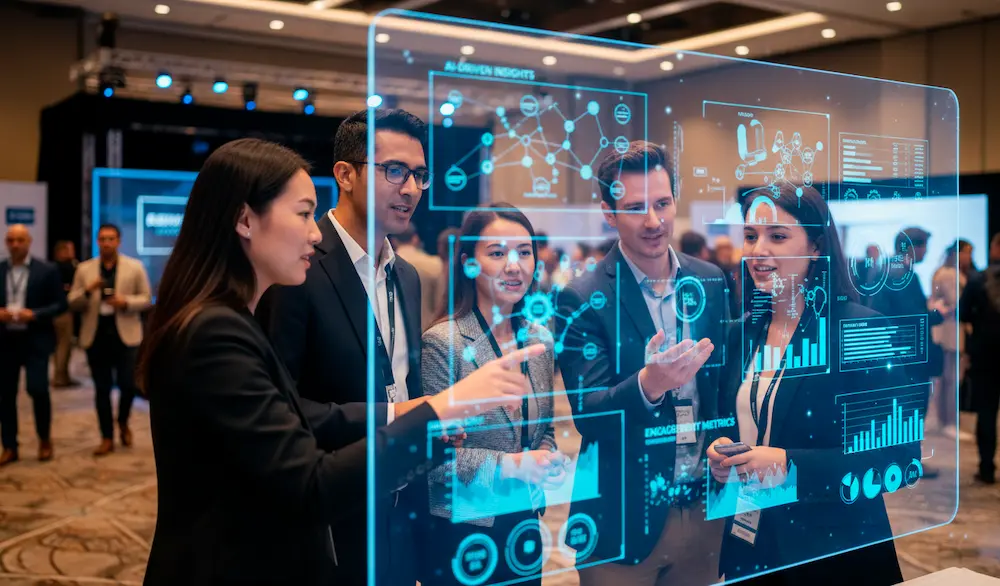
Data interpretation and decision-making
AI for events can highlight correlations, alerts or probabilities. What it cannot do effectively on its own is interpret business priorities, internal constraints or brand nuances. A pattern identified by a tool does not automatically translate into the right decision. Turning insight into action remains a human responsibility.
The practical rule: automate tasks, not relationships
The golden rule for Event Managers: automate tasks, not relationships. To avoid depersonalisation, professionals must clearly understand which situations require empathy or decision-making. High-context interactions, such as sponsor issues, complaints or VIP engagement, should never be fully delegated to a machine.
AI can prepare context and surface correlations, but people must always lead interactions in moments where trust is at stake.

How to apply this in your strategy
If you are evaluating how to apply AI for events effectively, start with three questions: which repetitive tasks consume the most time, which interactions you do not want to dehumanise, and what data you need to improve the experience without being intrusive. From there, you can build a model that is both more efficient and more credible.
From a platform like Eventscase, this can translate into combining operational automation, data and interaction with real team support. And if you want to explore further, you can visit this content: Introduction to AI in Events: Use Cases to Get Started