
The way people communicate has changed significantly in recent years. Instant messaging has become one of the most widely used channels for resolving questions, sharing information and holding quick conversations. Within this context, voice notes have taken on an increasingly important role.
In 2022, WhatsApp users were already sending an average of 7 billion voice messages every day. If we take into account that the platform surpassed 3 billion monthly active users in 2025, according to data shared by Meta, we can conclude that the number of voice messages has far exceeded that figure.
These figures reflect a clear reality: attendees do not arrive at an event with new digital habits, but with behaviours that are already well established. That is why a virtual event assistant such as EVA needs to integrate with the channels and formats people already use in their day-to-day lives.
Attendee support is evolving beyond text
Digital support at events has traditionally been linked to written channels: emails, forms, chats, frequently asked questions pages or mobile applications. All of them remain useful, but they do not always respond to the needs of an attendee on the move.
At an in-person event, context matters. An attendee may be arriving at the venue, moving between rooms, networking or checking the agenda while walking. In these situations, typing a question on a mobile phone can be impractical.
Allowing users to send a voice note enables a faster and more natural interaction. It does not replace text; rather, it adds another option within the support experience. A virtual event assistant that understands audio can better adapt to different moments, profiles and needs.

EVA incorporates WhatsApp voice notes
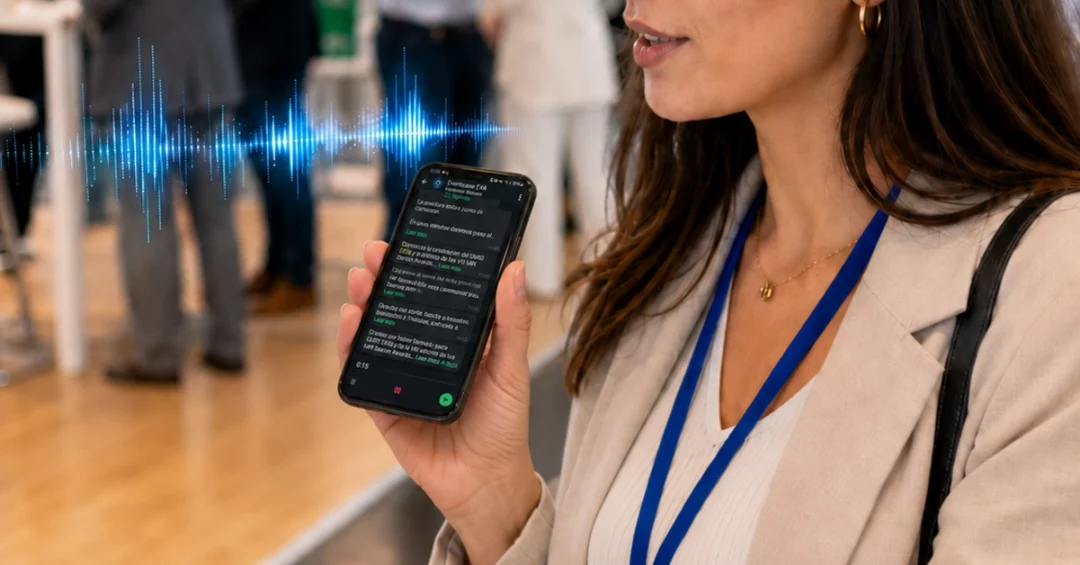
EVA, Eventscase’s AI, incorporates a new functionality that allows attendees to communicate with her through voice notes sent via WhatsApp.
The process is simple from the user’s point of view: the attendee records a voice note, sends it through WhatsApp, and EVA understands it, transcribes it, analyses the context and provides an appropriate response for the situation.
This evolution turns EVA into a more flexible and accessible virtual event assistant. The interaction no longer depends solely on the attendee typing their query correctly, but on their ability to express their need in whichever way is most convenient at that moment.
From audio to a contextualised response
The value of this functionality lies not only in receiving audio, but in turning it into useful information.
When an attendee sends a voice note, EVA can interpret the query, identify the intention behind the message and respond with information related to the event. This may include questions about the agenda, room locations, schedules, access, networking activities, speakers or practical information.
A virtual event assistant should not be limited to acting as a repository of answers. Its usefulness increases when it can understand the context, interpret the user’s need and offer a clear response in real time.
Why voice can improve the event experience
The incorporation of audio into a virtual event assistant responds to a broader trend: the search for simpler, faster and more accessible digital experiences.
Greater convenience for the attendee
Speaking can be more convenient than typing, especially when the user is on the move or needs to resolve a question quickly. Voice reduces friction and allows the interaction to take place at the very moment the need arises.
Greater accessibility
Not all attendees interact with technology in the same way. Some people may feel more comfortable speaking than typing on a mobile device. Others may need a more agile communication channel because of the event context itself. Incorporating voice broadens the ways in which attendees can access information.
Greater continuity in the experience
WhatsApp is a familiar tool for millions of users. Integrating a virtual event assistant into an already familiar channel reduces the learning curve and prevents attendees from having to adapt to a completely new environment in order to resolve a question.
Greater efficiency for the organisation
Many queries during an event are recurring. Automating part of that support makes it possible to respond quickly without overloading the organising team. This does not remove human support; rather, it helps prioritise resources more effectively and provide a constant first layer of assistance.
A more natural channel for more dynamic events
Events are living environments. Information changes, attendees move around and needs arise at very specific moments. That is why support technology needs to be able to keep pace with that rhythm.
A virtual event assistant with the ability to understand audio enables more fluid communication. The attendee can ask their question spontaneously and receive an answer without depending exclusively on written interfaces.
This functionality also reinforces an important idea: innovation in events does not always mean adding complexity. Often, it means simplifying the user experience and bringing technology closer to people’s real habits.
The role of the virtual event assistant in the future of communication
Voice is part of today’s digital communication. Its use on WhatsApp shows that many people already rely on audio to explain an idea more clearly, save time or communicate when writing is not the most convenient option.
Integrating that possibility into a virtual event assistant represents another step towards more adaptive support. It is not only about answering questions, but about offering communication channels that fit the attendee’s reality.
EVA already allowed attendees to communicate digitally during the event. Now, by understanding WhatsApp voice notes, it expands the possibilities for interaction and improves the accessibility of the service.
For organisers, this functionality represents an opportunity to offer support that is more immediate, scalable and aligned with today’s communication habits. For attendees, it provides a simpler way to access the information they need, when they need it.
As user experience becomes increasingly important, having a virtual event assistant capable of understanding voice, text and context can make a real difference to the quality of support.