

There are two moments at an event that almost single-handedly define how attendees perceive the quality of its organisation: the moment they arrive and what happens once they are inside. The first can turn a welcome into a twenty-minute queue. The second can make a well-produced conference feel like a watered-down experience because nobody could find the room, nobody knew when the next session started and networking was reduced to exchanging business cards.
Both problems have a solution. And Eventscase has just formalised its own with the launch of two products specifically designed to address them: the new check-in app and event app.
This is not a feature update or a rebrand. These are two tools with their own logic, built to work together but also designed so that each can independently solve the problem it was created for.
Why the timing of the launch matters
The global event apps market reached US$12.81 billion in 2024 and is expected to grow to US$54.79 billion by 2035, with a compound annual growth rate of 14.12%, according to Market Research Future. These figures reflect something any event manager in the MICE sector already sees on the ground: attendees’ expectations of technology have risen steadily, while tolerance for a mediocre digital experience is becoming increasingly limited.
More than 40% of event attendees say the right technology can make the event experience significantly easier, according to Freeman (2025). And when technology fails, the impact is immediate and visible: queues, lost attendees, sponsors without metrics and organisers putting out fires.
Eventscase knows this context well. It has spent years working on events of different scales, from corporate meetings for twenty people to international conferences, and knows that technology cannot simply be an aesthetic add-on. It has to work when it is needed most, even when network coverage fails and even when attendee volumes exceed expectations.
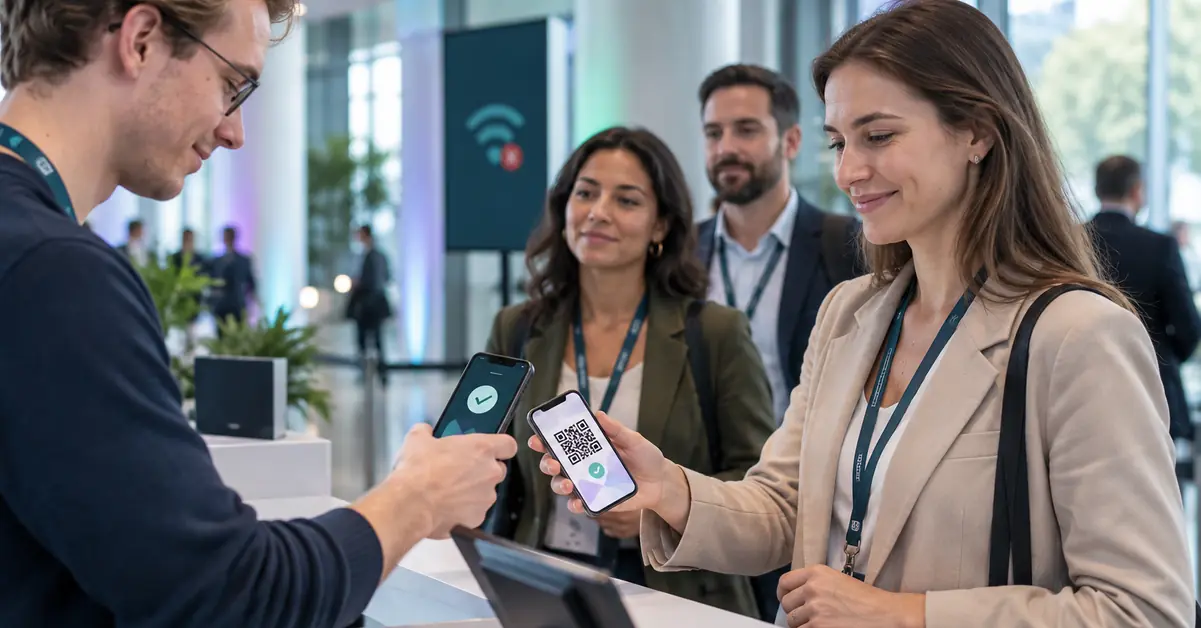
The check-in app: seamless access, even offline
Check-in is one of those processes that is taken for granted until something goes wrong. A scanner that will not scan, an out-of-date list, a QR code that will not load. What should take seconds becomes a bottleneck that damages perceptions of the event before it has even begun.
Check-in is a critical event process that needs to be fast, robust and professional. Eventscase systems work without an internet connection, helping to avoid coverage issues and slowdowns at the point of entry.
The Eventscase check-in app tracks attendance and audience flow at in-person events. Available on both Android and iOS, it allows organisers to manage attendee entry and exit for an event or for individual sessions, while making it easy to generate reports.
QR scanning is the main method, but not the only one
The app uses the mobile device’s camera as a QR code scanner for a faster arrival process, while also allowing staff to search for an attendee manually in the list.
This matters: at events with hundreds of people, there will always be someone who arrives without access to their digital accreditation, and that contingency needs to be resolved without disrupting the flow of entry.
From the organiser’s perspective, the dashboard is where the real value of the system becomes visible. Dashboard statistics show check-in data in real time: the total number of attendees registered on the approved list and the total number of attendees who have checked in at the event. Not historical data from last week, but data from right now, while the event is taking place.
The access-control software does more than validate tickets: it controls access by ticket type, manages exclusive areas and generates flow data that supports operational decisions in real time. Eventscase has a team of professionals with years of experience in the sector who support organisers in designing and planning access control so everything runs smoothly.

The event app: the event in the attendee’s pocket
If the check-in app solves the first critical moment, the event app is the tool that determines the quality of the attendee experience for the rest of the day. Agenda, sessions, speakers, venue map, push notifications, networking: everything is centralised in a native app that attendees can download before they arrive.
Eventscase’s proposition in this area is clear
Attendees can access all event information — agenda, speakers, sponsors, exhibitors, maps and other content — from their mobile phones, while organisers can update the app’s appearance and content easily and in real time, with minimal effort.
The Eventscase event app can be fully adapted to the organiser’s brand, with no “Powered by” label or similar branding. This is not a minor detail: at corporate events or conferences run by professional associations, brand identity is part of the value delivered to both sponsors and attendees.
The networking module deserves a special mention
One of the main reasons people attend events is to make valuable contacts and generate potential clients and synergies, and that does not happen by magic: it requires a professional networking system. The app includes a flexible meeting system, automatic contact recommendations, real-time chat and push notifications to make communication easier before, during and after the event.
The case is just as strong for sponsors and exhibitors. Sponsors and exhibitors want to know how much impact they have had, and the app provides detailed reports on user activity, sponsor and exhibitor impact, the most successful sessions and those with the lowest demand. That data can make the difference between renewing a sponsorship and losing it.

Integration as a genuine advantage
What sets these two tools apart from standalone solutions is that they are part of an ecosystem. Registration, the check-in app and the event app share the same database: a registered attendee can check in using their QR code and access the app with the same credentials. No duplication, no manual exports and no room for human error.
Registration is the cornerstone of an event. By using Eventscase’s all-in-one event management software, data remains synchronised at all times. For example, organisers can control which content each type of attendee sees in the app based on the ticket they purchased or the registration link they used.
This integrated-platform approach responds to one of the sector’s main demands. Agencies and organisers that implement automation software reduce their operational workload by between 27% and 40%. That reduction does not come from removing people, but from eliminating repetitive tasks and friction points that add no value.
When event access management is approached with this level of integration, it stops being a purely logistical problem and becomes a source of data on attendee behaviour: who arrived and when, which sessions they attended and which areas they visited. Information that feeds directly into planning for the next edition.
A commitment to the complete experience
The direction of travel in the MICE sector is towards events where technology acts as an invisible fabric: it does not draw attention to itself, but it makes everything flow more smoothly. This personalisation is reinforced by technology such as virtual assistants, recommendation systems, apps that adjust suggested agendas in real time and intelligent networking tools.
The launch of Eventscase’s check-in app and event app fits squarely within that direction. They are not cutting-edge technology tools per se; they are tools that solve specific problems with precision, reliability and minimal friction. The check-in app working offline, the event app being published under the client’s own brand, and both tools sharing data in real time with the rest of the platform: these are the details that make the difference once the event has started and there is no room for error.
If you would like to explore how these tools work in more detail or see how they could fit into the operations of your next event, this post includes practical resources on technology applied to the attendee experience, access control and on-site event management.